
About
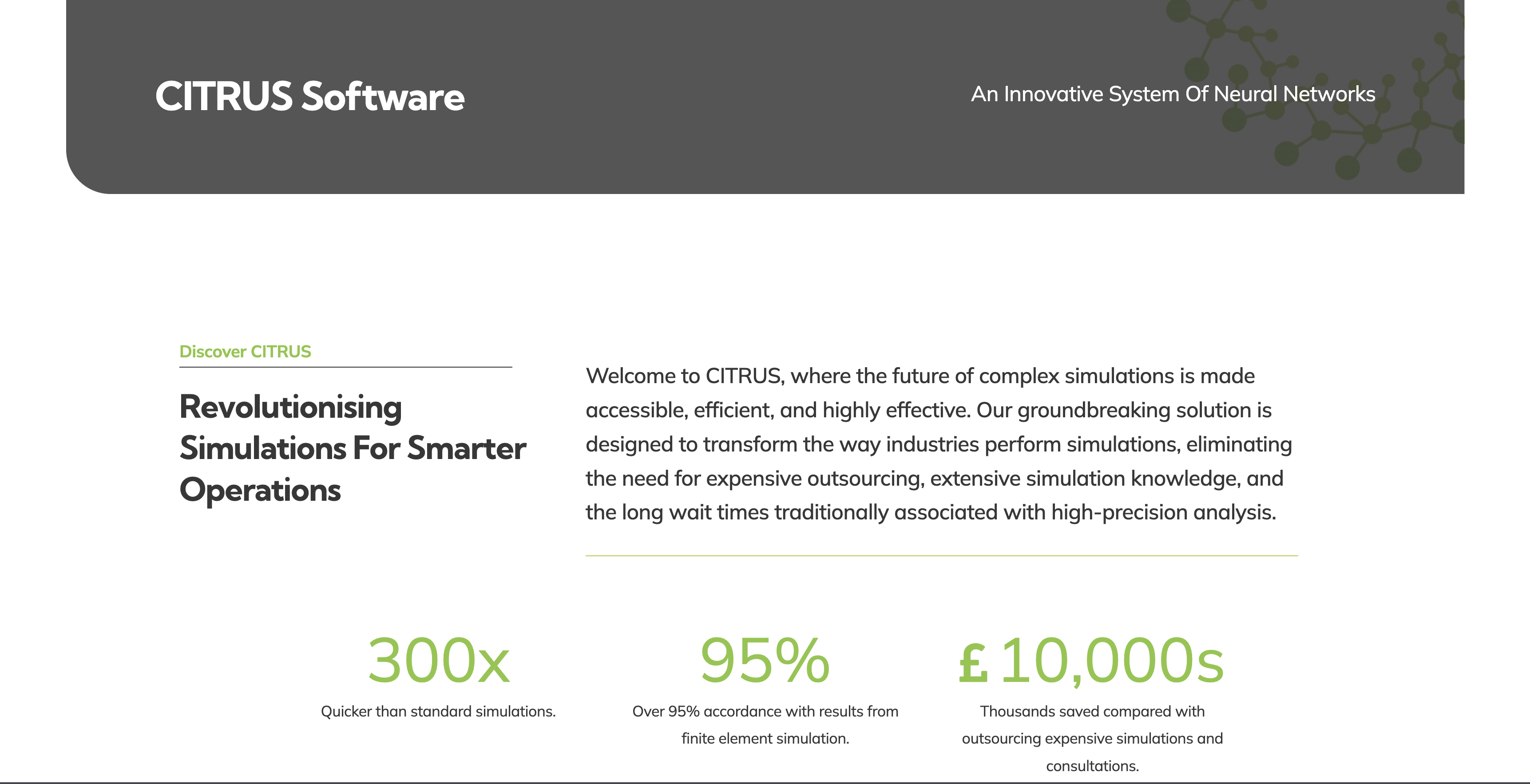
CITRUS was a collaboration between the Digital Research Service (DRS) and Christopher Hyde and Benedikt Engel from the Faculty of Engineering at the University of Nottingham. They had previously worked on a process to estimate thermal stress on power plant components that was as good as Finite Element Modelling (FEM), which is a time and compute intensive process (Rouse & Hyde, 2016). They then produced a neural network model which could be used to perform these estimates (Rouse, Hyde & Morris, 2018). Following this work, Christopher and Benedikt wished to build a proof-of-concept application around the model.
The application needed to accept a time series of temperature data from sensors on the power plant component – in this scenario, a steam head – as well as the spatial coordinates of the sensors and then use the model to predict the changes in thermal stress over the time series. We designed and implemented a web user interface using the Django framework in Python which did this and plotted the outputs which could then be interrogated by users.
The main technical challenge of CITRUS was around how to deploy the model and then take the predictions and perform the downstream calculations, that produced the stress response curves, in a timely manner. The process was meant to be a faster version of FEM, which requires immense amounts of time and compute, necessitating the use of a high-performance computer (HPC) to calculate the stress response curve for a single degree change in temperature. CITRUS also had to handle missing data points where sensors had failed or cut out temporarily. This involved interpolation that used the temperatures before and after a gap to determine how to fill it. Interpolation was performed automatically when the user uploaded their data, rather than needing to be done manually. CITRUS also utilised multi-processing to leverage more of a computer’s processor to handle more calculations at a time. CITRUS could calculate the curve over several degree changes in a similar time to FEM with a HPC, but it only required a laptop.
Following the success of the CITRUS project, Christopher and Benedikt went on to found MatAlytics Ltd. In 2023. In their own words: “Matalytics Ltd. is dedicated to deliver innovative ideas and solutions to the power generation industry. By leveraging cutting-edge neural networks, advanced calculation algorithms with comprehensive mechanical and material expertise, Matalytics Ltd. specializes in providing real-time physical-based information to power generation companies and power plant operators.”
References
Rouse, J. and Hyde, C. (2016). A Comparison of Simple Methods to Incorporate Material Temperature Dependency in the Green’s Function Method for Estimating Transient Thermal Stresses in Thick-Walled Power Plant Components. Materials, 9(1), p.26. doi:https://doi.org/10.3390/ma9010026.
Rouse, J.P., Hyde, C.J. and Morris, A. (2018). A neural network approach for determining spatial and geometry dependent Green’s functions for thermal stress approximation in power plant header components. International Journal of Pressure Vessels and Piping, 168, pp.269–288. doi:https://doi.org/10.1016/j.ijpvp.2018.10.020.
Links
MatAlytics Ltd. on LinkedIn: https://www.linkedin.com/company/matalytics/posts/?feedView=all
MatAlytics Ltd. website: https://matalytics.com/
Leave a Reply